
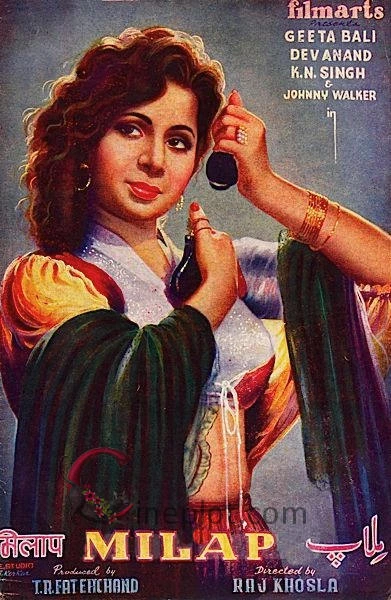
Milap (1955)
Year – 1955
Language – Hindi
Country – India
Producer – Film Arts
Director – Raj Khosla
Music Director – N. DUtta
Box-Office Status –
Cast – Geeta Bali, Dev Anand, Rajinder, Krishan Dhawan, Johnny Walker, K. N. Singh
Songs List
Review
At a time when good comedies are few and far between comes Filmarts ‘ “Milap,” produced by T. R. Fatehchand and directed by Raj Khosla. The film, which is young Khosla’s directorial assignment, was premiered on February 4th, 1955 at the Swastik Cinema.
The theme, though reminiscent of the Capra hit, “Mr. Deeds Goes To Town,” has been cleverly adapted to the Indian screen. It has a well-knit plot and presents a variety of compelling characters and incidents. Told lucidly, the story moves from scintillating romance to high-voltage- drama, with vivid human appeal right through.
Starting on a note of comedy, the story narrates the experiences of a naive rustic youth who suddenly inherits a vast fortune and goes to Bombay to claim it. His strange experiences as an embarrassed youth who finds himself the center of attraction in the mad social whirl of a big city provides the makers of the film with excellent opportunities to introduce comedy with a streak of sarcasm in it.
His strange, bewildering experiences as a lone man pitched against the machinations of crafty men plotting to deprive him of his unexpected inheritance, his disillusionment when he finds his beloved a party to their diabolic plot, his ultimate victory over the forces of darkness and evil and a grand, climactic reunion with his beloved make “Milap” a thoroughly enjoyable film.
Though this is his initial essay on the screen, Raj Khosla, the young and enterprising director, has not betrayed any unfamiliarity with the megaphone anywhere in the film. On the contrary, his deft directorial touches in it could do credit to a veteran. Kudos should also go to Nabendu Ghosh who wrote the screenplay and Rajendrasingh Bedi who did the dialogue.
Dev Anand as the artless village youth who refuses to be corrupted by wealth and its attendant evils dominates the entire length of the film, putting in a truly memorable portrayal. He is seen at his best in the early sequences of the film, where he is the embarrassed youth whose ways are ridiculed by the sophisticates of the city. It can safely be said that this is just about his best performance to date.
Sharing honors with Dev is the versatile Geeta Bali, cast as a scheming decoy completely won over by the sincerity of her victim. Gay, uninhibited, she sparkles through the picture, filling it with an irresistible appeal as she sings, romps, romances and dances her way through the light-hearted sequences. She is equally brilliant in the passages where the story takes a grim turn. There is no question of her versatility.
Pitched in the film against several consistent performers, Johnny Walker manages to make his presence felt in the comic passages. As Dev Anand’s loyal shadow, unaffected by the blandishments of urban life, his clowning is almost Chaplinesque in its broad, brilliant humanity and its reflections on life around him.
K. N. Singh has a role written almost entirely for him and is convincing as the scheming lawyer who is outwitted finally by a simple village lad.
Others who add to the histrionic appeal of the film are Uma Devi as the funny “Memsahib,” Kumkum who makes a most delightful nautch-girl, and Krishan Dhawan as the fugitive who constantly scrounges on his sister.
The lyrics have a fine poetic appeal, and the music score is delightful though not particularly distinguished. V. K. Murthy who cranked the camera has done a commendable job.













Leave A Comment